Modern smart intersections require communication systems that are reliable, low-power, secure, and capable of operating across dense urban environments. Traditional wireless technologies often struggle to balance all of these requirements simultaneously.
This is where LoRa becomes highly effective. LoRa (Long Range) is a low-power wide-area networking technology designed for long-range communication with minimal energy consumption. Unlike conventional Wi-Fi or short-range protocols, LoRa enables devices to communicate across several kilometers while using extremely low power.
According to Semtech LoRa Technology Overview, LoRa networks are specifically optimized for IoT and smart infrastructure applications requiring long-range and low-bandwidth communication.
How Greenwave TechLabs Uses LoRa
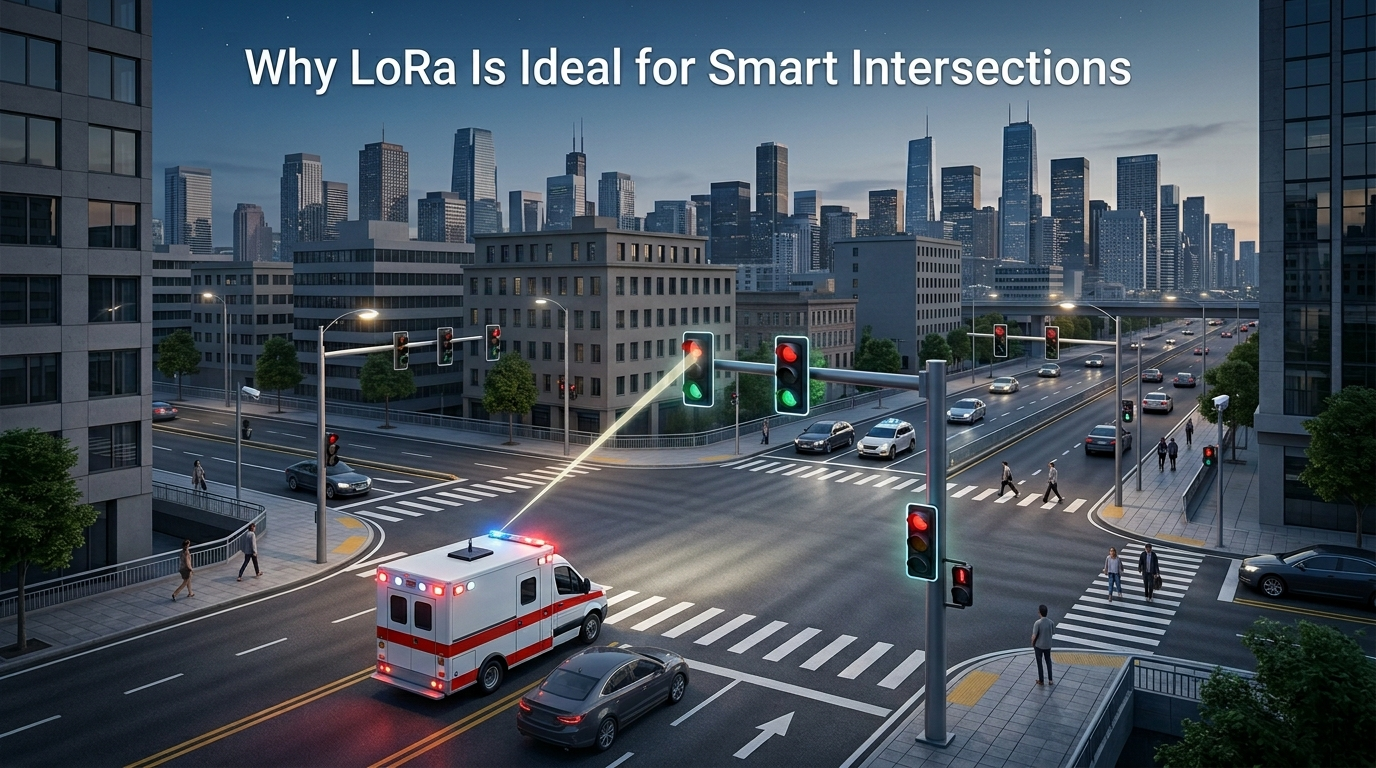
At Greenwave TechLabs, LoRa forms the foundation of the Vehicle-to-Infrastructure (V2I) communication layer within our emergency traffic preemption framework. When an authorized ambulance approaches an intersection, the vehicle transmits an authenticated wireless request to the Traffic Signal Receiver Unit (TSRU), enabling the system to dynamically prioritize traffic flow.
Why LoRa Was Selected
- Long communication range across urban environments
- Low power consumption for scalable deployment
- Strong signal penetration through buildings and obstacles
- Low infrastructure cost
- Reliable operation without cellular dependency
Performance Results
- 98.6% packet success rate
- Approximately 210ms round-trip latency
- Secure authenticated communication
- Reliable operation under urban conditions
LoRa vs. Other Protocols
Unlike high-bandwidth systems such as 5G or DSRC, LoRa is optimized for lightweight telemetry and signaling rather than continuous high-speed data transfer. This makes it highly suitable for emergency signal requests, intersection coordination, roadside sensor communication, and distributed infrastructure monitoring.
Another major advantage is deployment cost. LoRa-based systems can be deployed at significantly lower cost while remaining scalable across multiple intersections and traffic corridors. The architecture also supports decentralized edge intelligence — because communication occurs directly between vehicles and intersections, the system can continue operating even during internet outages or cloud service interruptions.
For smart intersections, LoRa is not simply a communication protocol. It is an enabling layer for intelligent urban mobility.