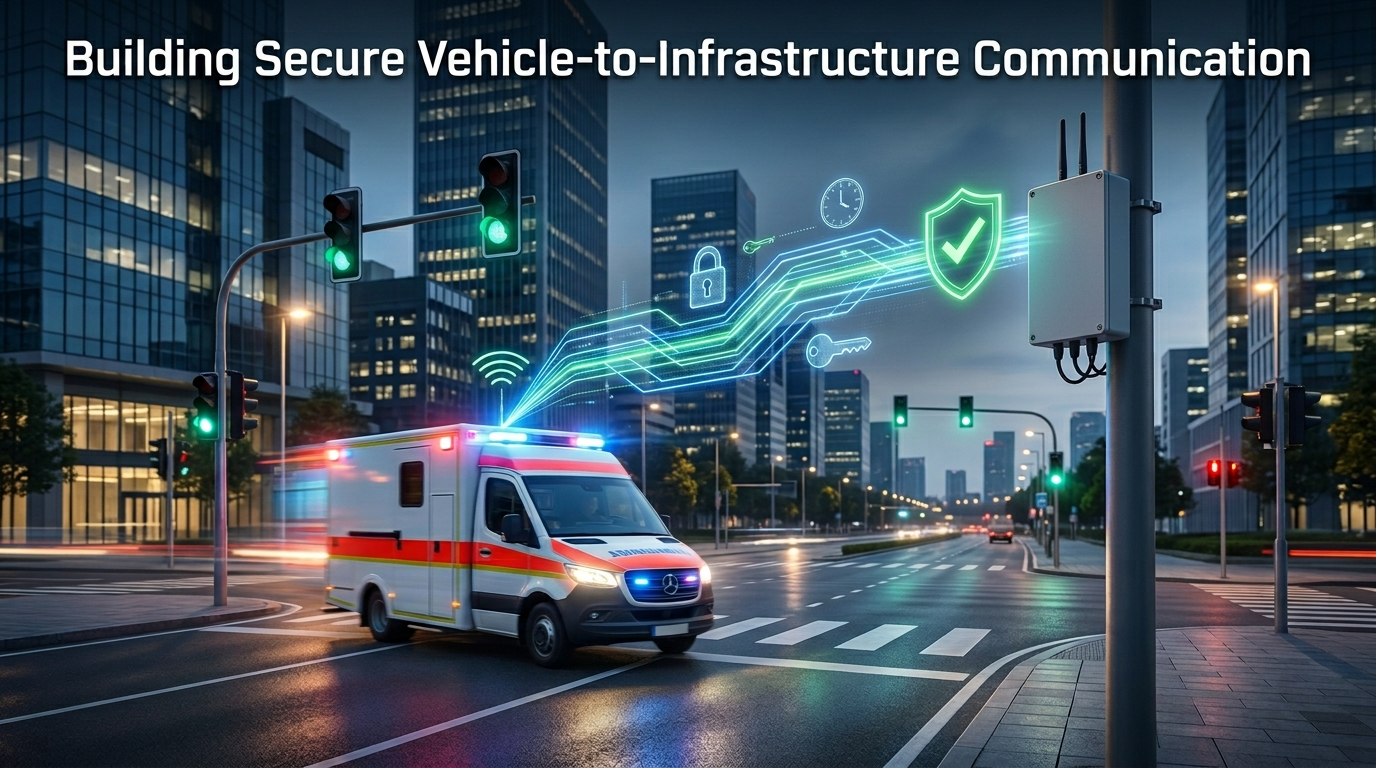
As transportation systems become increasingly connected, security becomes just as important as functionality. Vehicle-to-Infrastructure (V2I) communication enables vehicles to exchange data with traffic signals, roadside units, and intelligent transportation systems in real time.
While this creates powerful opportunities for smart mobility, it also introduces serious cybersecurity risks. If a malicious actor gains access to traffic communication systems, the consequences could include false traffic preemption, intersection disruption, unauthorized signal control, denial-of-service attacks, and large-scale traffic manipulation.
According to National Highway Traffic Safety Administration Cybersecurity Guidance, connected transportation infrastructure must integrate secure authentication and communication mechanisms to prevent misuse and malicious access.
Our Secure V2I Architecture
At Greenwave TechLabs, secure communication is a foundational component of our intelligent emergency traffic system. Our framework uses a secure LoRa-based V2I architecture that integrates Pre-Shared Key (PSK) authentication, HMAC-based packet validation, timestamp verification, replay attack protection, and authenticated emergency requests.
Communication Workflow
- Emergency vehicle transmits an authenticated LoRa packet
- Traffic receiver validates the authentication token
- Timestamp is checked against a secure acceptance window
- Only verified requests trigger signal preemption
Spoofing and Replay Defenses
One of the major threats in V2I systems is spoofing. Without authentication, attackers could transmit fake emergency requests to trigger false green signals. To prevent this, our system verifies all incoming packets using lightweight cryptographic authentication mechanisms.
For replay attacks, our framework mitigates the risk by validating timestamps within a narrow time window of approximately ±2 seconds. Any delayed or reused packet is automatically rejected.
According to IEEE Vehicular Technology Society, authentication and secure message verification are essential components of modern intelligent transportation systems.
Balancing Security and Performance
The challenge is balancing security with computational efficiency. Traffic infrastructure often operates on low-power embedded hardware where traditional heavyweight encryption methods may introduce latency or excessive resource usage. Our approach was designed specifically for lightweight execution, low-cost deployment, embedded processing, and real-time communication.
The result is a V2I framework capable of operating securely within real-world smart city infrastructure while maintaining sub-second emergency response performance. As intelligent transportation networks continue expanding, cybersecurity will become increasingly central to public infrastructure design. Future smart cities will not only need connected systems — they will need trusted systems.