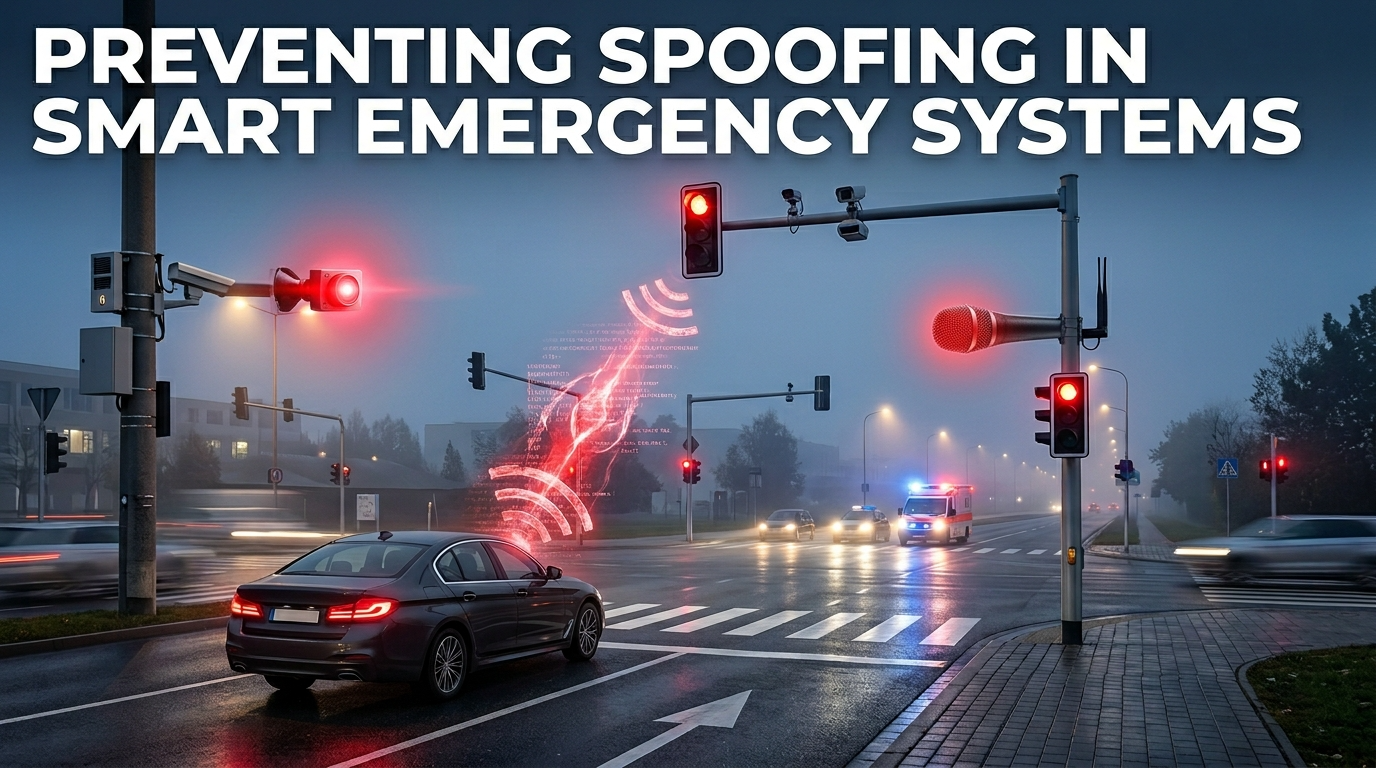
As emergency traffic systems become smarter and more connected, they also become targets for cyber threats. One of the most dangerous risks in intelligent transportation infrastructure is spoofing — the act of impersonating a legitimate emergency vehicle or sensor in order to manipulate traffic systems.
In a poorly secured environment, an attacker could potentially trigger false green lights, manipulate intersection behavior, disrupt emergency traffic coordination, create dangerous traffic conflicts, and compromise public safety systems.
According to Cybersecurity and Infrastructure Security Agency, connected infrastructure systems require strong authentication and resilient communication protocols to protect against unauthorized access and malicious interference.
Vulnerabilities in Traditional Systems
Traditional emergency vehicle preemption systems often rely on single-mode detection methods such as siren recognition, infrared signaling, or unsecured wireless transmission. These systems can be vulnerable to false triggers or malicious spoofing attempts.
Our Multi-Modal Defense
At Greenwave TechLabs, preventing spoofing attacks was a core requirement during the development of our multi-modal emergency traffic architecture. Our framework protects against multiple threat vectors through layered security and redundant verification.
- Authenticated LoRa V2I communication
- Acoustic CNN-based siren verification
- YOLO-based visual confirmation
- Fusion-based decision logic
This multi-modal approach significantly reduces the likelihood of false activation. A fake siren recording alone cannot trigger full system preemption. A spoofed visual input without authenticated communication is insufficient. Invalid LoRa packets are rejected immediately.
The Fusion Logic
The architecture uses PSK-based HMAC authentication, timestamp validation, replay attack prevention, and multi-layer detection redundancy. The proposed fusion logic — (V2I is valid) OR (Acoustic AND Visual are valid) — provides a balance between operational reliability, fail-safe redundancy, and cybersecurity protection.
Validation Results
The system was specifically evaluated against sensory spoofing attacks, replay attacks, fake LoRa transmissions, and partial sensor failures. Experimental validation showed that the proposed logic successfully rejected spoofed sensory attacks while still maintaining reliable emergency preemption under degraded conditions.
According to CISA Zero Trust Guidance, modern infrastructure security increasingly depends on layered verification and continuous authentication rather than trusting any single source of input. This principle directly applies to intelligent transportation systems. Public safety systems cannot afford blind trust — they require intelligent verification.