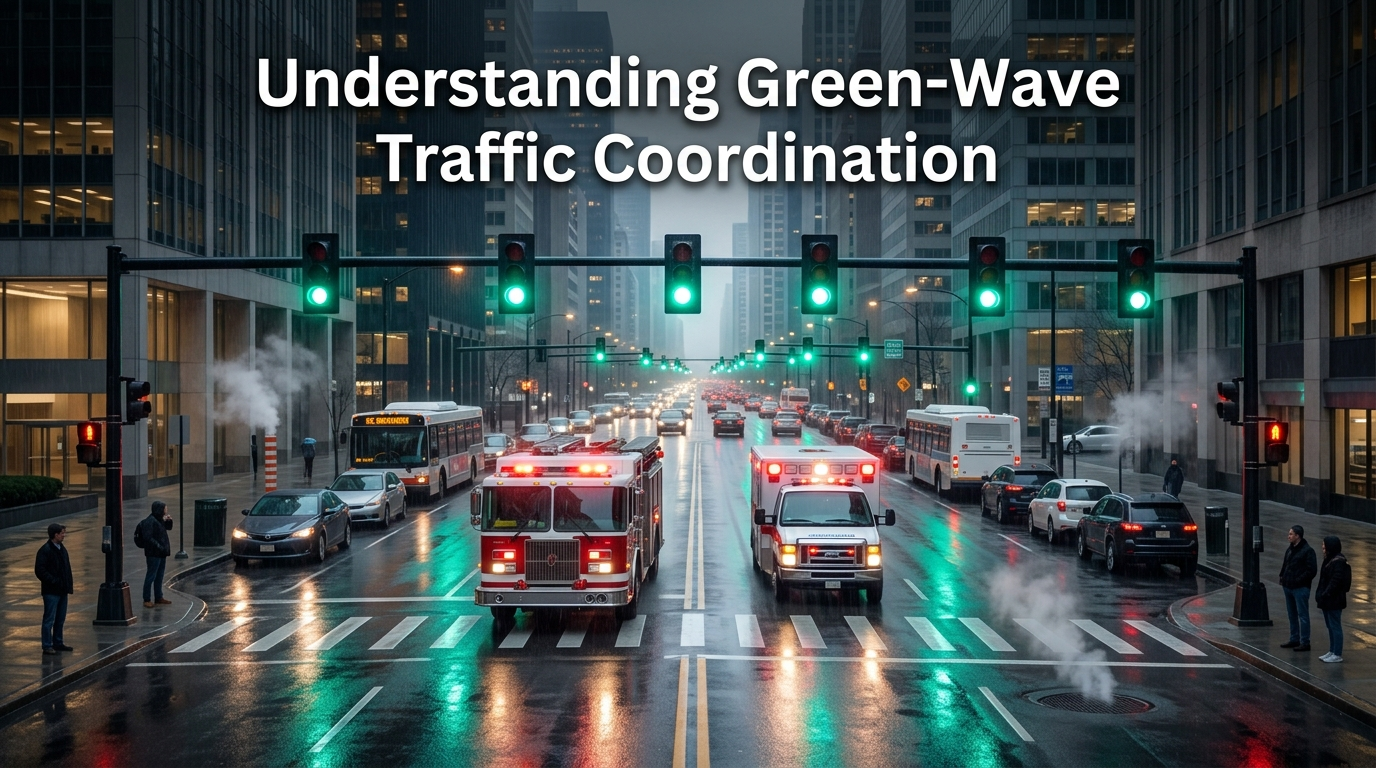
One of the biggest causes of emergency vehicle delay in urban environments is repeated stopping at traffic intersections. Even when roads are partially clear, emergency responders often lose critical seconds waiting for traffic lights to change. Over multiple intersections, these delays compound into major response-time losses.
Green-wave coordination was designed to solve this problem. A green-wave corridor is a synchronized sequence of traffic signals configured to create uninterrupted movement along a vehicle's route. Instead of stopping at each intersection, the emergency vehicle encounters a continuous progression of green lights.
According to Federal Highway Administration Intelligent Transportation Systems, coordinated signal systems significantly improve traffic efficiency and emergency response performance.
How Our System Works
At Greenwave TechLabs, green-wave synchronization forms a central component of our intelligent emergency mobility framework. Our system dynamically coordinates multiple intersections using secure LoRa communication, embedded AI detection, centralized traffic synchronization, and real-time signal coordination.
The Coordination Sequence
- Intersections receive synchronized preemption commands
- Traffic signals adapt dynamically
- A continuous priority corridor is created
- Civilian traffic is managed adaptively
Benefits
- Reduced emergency response time
- Fewer intersection stops
- Improved traffic stability
- Lower accident risk
- Reduced fuel consumption
- Lower emissions
Research studies on adaptive signal preemption have demonstrated measurable reductions in emergency travel delay through coordinated signal systems.
Dynamic vs. Static Systems
Traditional traffic systems operate using static timing cycles. Green-wave systems are fundamentally different because they react dynamically in real time. This requires predictive coordination, low-latency communication, distributed decision making, and intelligent traffic control.
Our framework validated multi-intersection synchronization through real-world prototype testing. The centralized coordination layer successfully generated dynamic emergency corridors with sub-second response performance. As cities become denser, adaptive mobility systems will become increasingly essential.