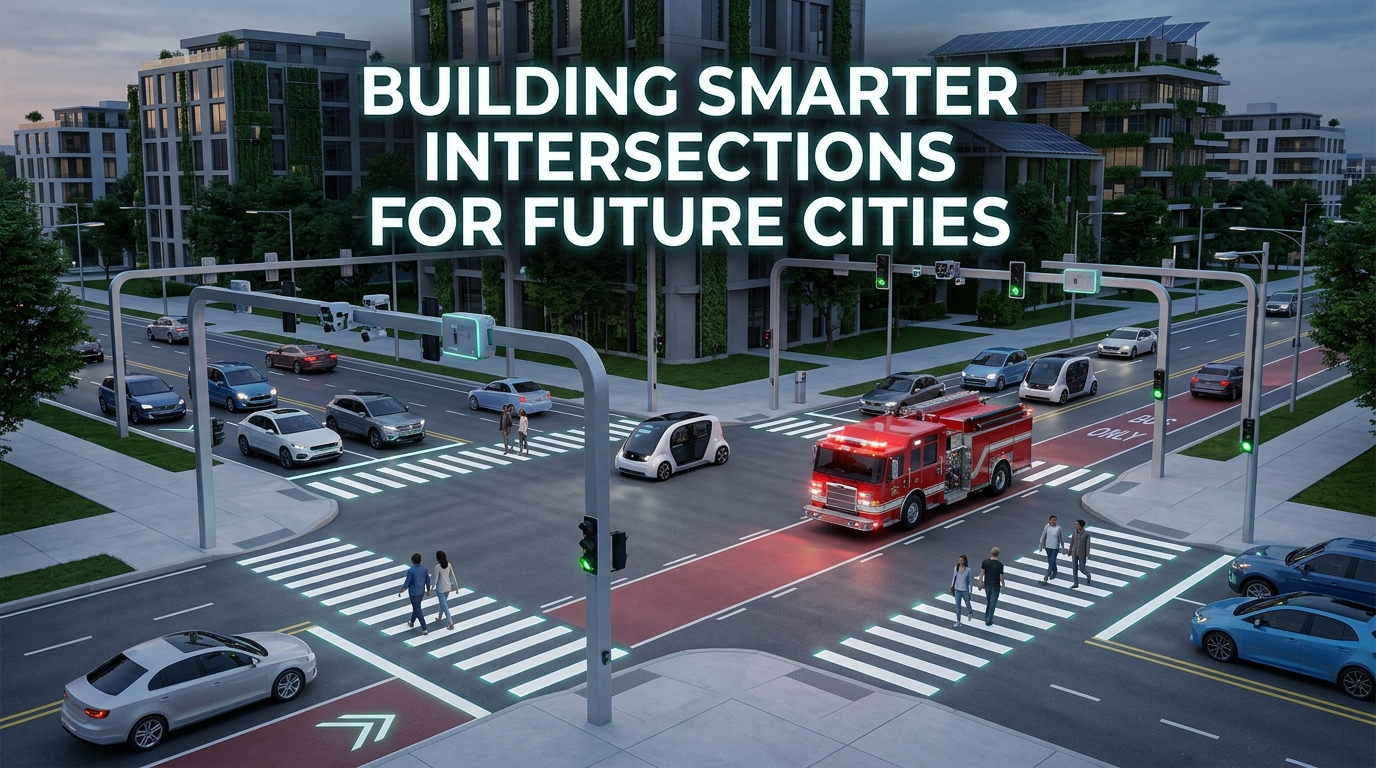
Urban intersections are among the most critical control points within modern transportation systems. Every day, intersections manage vehicle flow, pedestrian movement, emergency access, traffic prioritization, and public safety coordination.
Traditional intersections operate using static timing systems that cannot adapt intelligently to real-time conditions. As urban populations grow and congestion intensifies, these systems become increasingly inefficient.
What Future Intersections Must Do
- Observe traffic conditions
- Analyze real-time data
- Communicate with vehicles
- Adapt dynamically
- Prioritize emergencies intelligently
Greenwave TechLabs Architecture
At Greenwave TechLabs, our research focuses on transforming intersections into intelligent infrastructure nodes powered by embedded AI and multi-modal communication. Our architecture integrates edge AI inference, secure LoRa V2I communication, YOLO-based computer vision, CNN-based acoustic detection, and real-time signal coordination.
According to World Economic Forum Smart Cities Research, future smart cities will depend heavily on intelligent transportation systems capable of real-time adaptive operation.
Advantages of Smarter Intersections
- Reduced congestion
- Improved emergency response
- Safer pedestrian mobility
- Lower emissions
- Adaptive traffic optimization
- Infrastructure scalability
Edge vs. Centralized Processing
Unlike centralized traffic systems, edge-enabled intersections can process data locally, reducing latency, cloud dependency, communication overhead, and network vulnerability. This decentralized intelligence becomes increasingly important during emergencies where immediate decision-making is required.
Prototype Results
- Sub-second preemption response
- 98.6% V2I reliability
- Robust operation under partial sensor failure
- Scalable multi-intersection synchronization
Future intersections will likely integrate autonomous vehicle coordination, V2X communication, predictive traffic analytics, adaptive pedestrian systems, and AI-driven mobility optimization. Traffic signals will no longer operate as isolated devices — they will function as intelligent infrastructure agents continuously interacting with the urban environment.