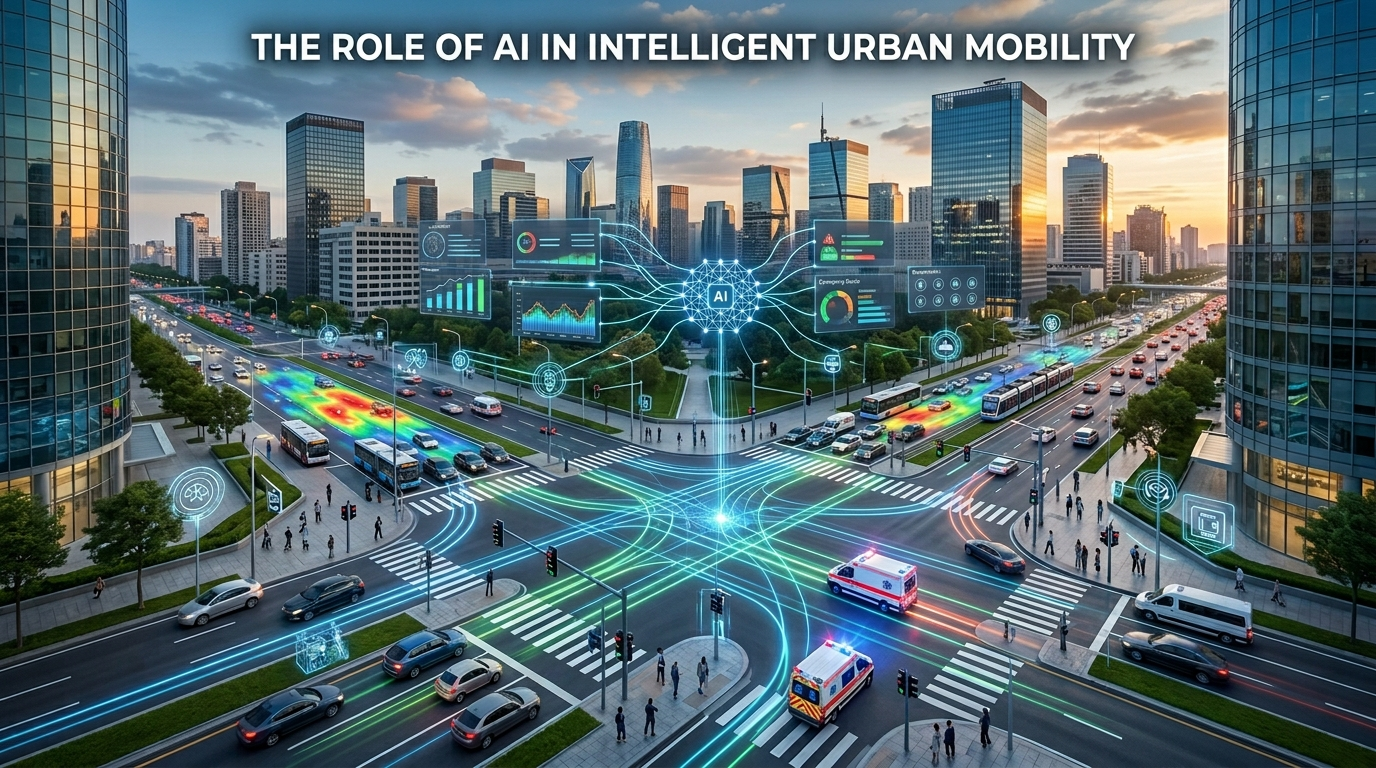
Urban transportation systems are becoming increasingly complex. Growing population density, traffic congestion, emergency response delays, and infrastructure limitations are forcing cities to rethink how mobility systems operate.
Artificial intelligence is emerging as one of the most important technologies driving this transformation.
What AI Enables in Transportation
- Analyze traffic patterns
- Predict congestion
- Coordinate intersections
- Optimize signal timing
- Detect emergencies
- Automate decision-making in real time
According to McKinsey Smart Mobility Research, AI-driven mobility systems can significantly improve traffic efficiency, reduce congestion, and support sustainable urban transportation.
Greenwave TechLabs AI Framework
At Greenwave TechLabs, AI forms the core intelligence layer of our emergency mobility infrastructure. Our system combines embedded CNN siren recognition, YOLO computer vision, real-time fusion logic, adaptive signal coordination, and edge-based decision making to enable intelligent emergency traffic prioritization.
From Reactive to Predictive
Traditional transportation systems are reactive. AI-enabled systems become predictive and adaptive. Traffic congestion can be anticipated before it escalates, emergency corridors can be synchronized dynamically, intersections can adjust behavior in real time, and infrastructure can coordinate collectively.
Decentralized Intelligence Through Edge Computing
AI also enables decentralized operation through edge computing. Instead of depending entirely on centralized servers, intelligent infrastructure can process information locally at intersections, roadside units, embedded devices, and connected traffic systems — reducing latency, bandwidth dependency, operational delay, and cloud processing load.
According to NVIDIA Smart Cities AI Research, AI-powered smart city infrastructure is expected to drive major advances in urban safety, traffic management, public transportation, environmental sustainability, and emergency response systems.
The Future of Urban Mobility
Our framework demonstrated how embedded AI can operate directly on low-cost edge hardware while maintaining real-time response, fault tolerance, scalability, and secure operation. The future of urban mobility will depend on systems capable of sensing continuously, learning dynamically, coordinating autonomously, and reacting instantly. Future cities will not simply manage traffic — they will understand it.