Emergency traffic systems operate under strict timing constraints. During emergencies, authentication mechanisms must be secure, fast, lightweight, low-latency, and computationally efficient.
Traditional enterprise-grade cryptographic systems often consume too much processing power for embedded smart-city infrastructure. Many traffic systems operate on low-power edge hardware with limited memory and real-time execution requirements.
This creates a difficult engineering challenge: how do you secure critical infrastructure without slowing it down?
Our Lightweight Authentication Approach
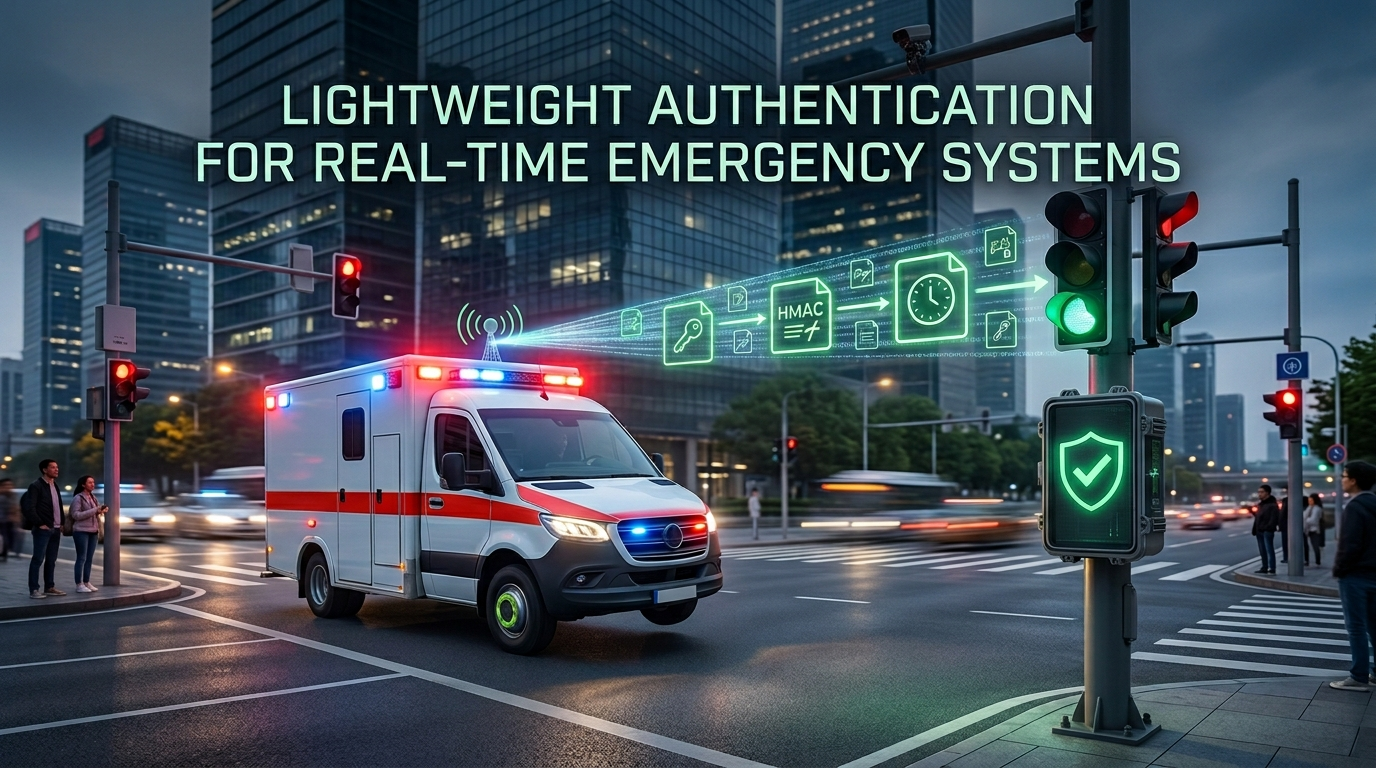
At Greenwave TechLabs, our emergency preemption framework was designed specifically for lightweight real-time authentication. The system uses Pre-Shared Key authentication, HMAC verification, timestamp validation, and lightweight packet integrity checks within the LoRa V2I communication layer.
- Low processing cost
- Rapid verification
- Embedded deployment compatibility
- Minimal communication delay
Authentication Workflow
- Generate authenticated LoRa packets
- Validate packet signatures
- Verify timestamps
- Reject spoofed or delayed transmissions
Performance Results
- Sub-second response time
- 98.6% communication reliability
- Approximately 210ms RTT latency
According to NIST Lightweight Cryptography Project, lightweight cryptographic systems are increasingly essential for IoT and embedded infrastructure where resource constraints make traditional security approaches impractical.
Scaling to Future Smart Cities
If authentication becomes too computationally expensive, response times increase, emergency latency rises, scalability decreases, and infrastructure costs grow. Our architecture balances security and responsiveness through edge-oriented lightweight verification.
Future transportation systems will rely on billions of embedded communications occurring continuously in real time. Security mechanisms must therefore scale efficiently without compromising performance. The strongest infrastructure is not necessarily the heaviest — it is the infrastructure capable of remaining both secure and responsive simultaneously.