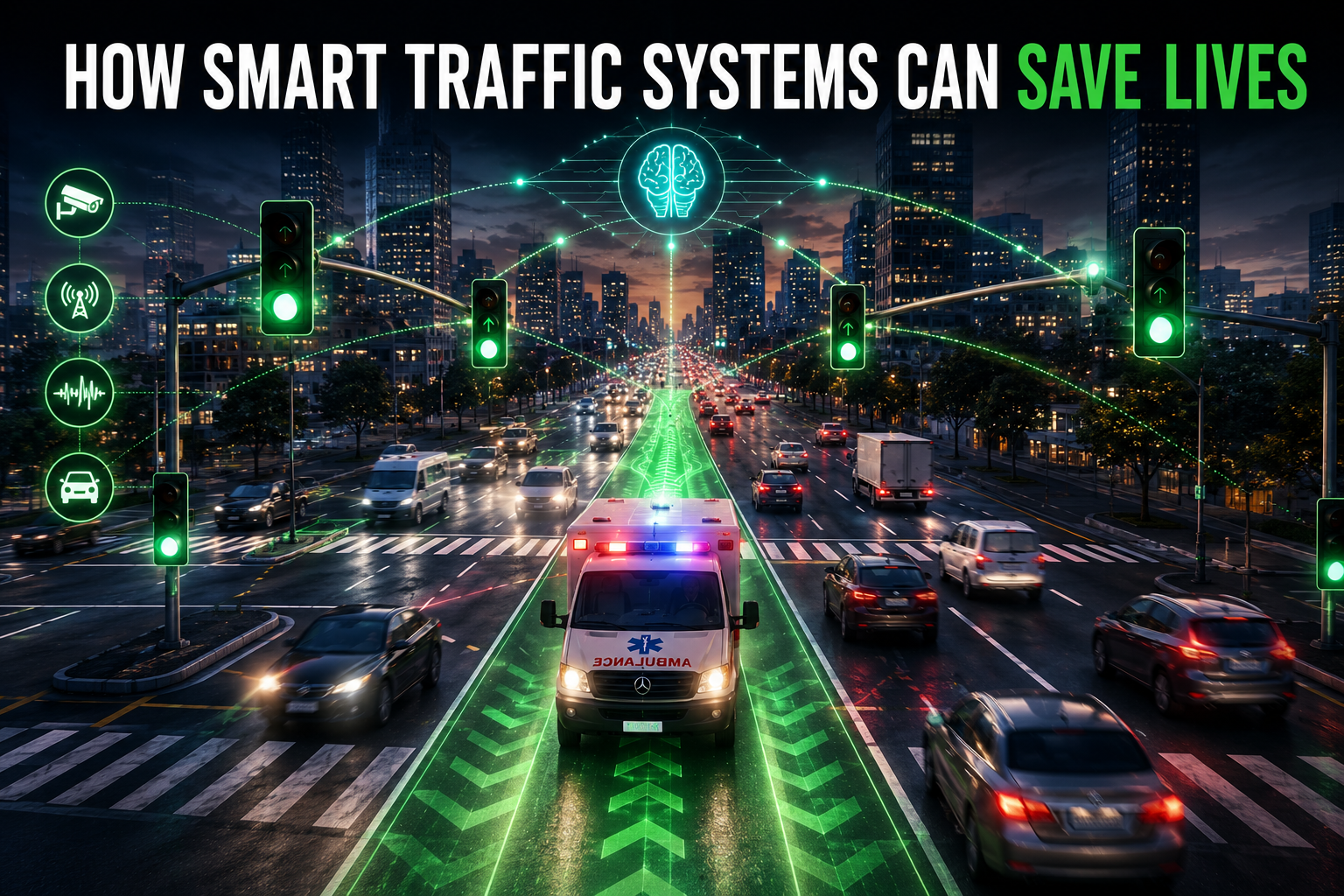
Traffic lights were originally designed for vehicle flow. Today, they must also protect human life.
As cities evolve into intelligent urban ecosystems, traffic infrastructure is becoming more adaptive, connected, and responsive. One of the most important applications of this transformation is emergency vehicle prioritization.
The Problem with Static Systems
Traditional signal systems operate using fixed timing cycles. But emergencies are unpredictable. When an ambulance approaches an intersection, static systems cannot react dynamically — forcing emergency responders to slow down, wait through traffic cycles, or navigate dangerous cross-traffic conditions.
How Smart Systems Change Everything
Using a combination of modern technologies, smart systems can identify emergency vehicles in real time and automatically clear their route:
- AI-powered detection
- Vehicle-to-Infrastructure (V2I) communication
- Computer vision
- Acoustic siren recognition
- Adaptive signal coordination
Research on emergency signal preemption demonstrated 14–23% reductions in response times, while intelligent adaptive systems have shown travel-time improvements exceeding 60% in simulation environments.
Beyond Single Intersection Preemption
Advanced systems can coordinate entire corridors simultaneously:
- Synchronize multiple intersections
- Create dynamic green-wave corridors
- Reduce emergency vehicle stopping frequency
- Improve traffic recovery after preemption
- Minimize disruption to civilian traffic
The Greenwave TechLabs Approach
At Greenwave TechLabs, our research builds multi-modal emergency traffic systems combining:
- Secure LoRa-based V2I communication
- Embedded AI siren detection
- YOLO-based computer vision
- Redundant fusion logic for reliability
Our prototype achieved:
- 95.6% siren detection accuracy
- 0.895 mAP visual precision
- Sub-second signal preemption latency
- 98.6% LoRa packet reliability
The future of emergency response will not rely solely on faster vehicles. It will rely on cities that can think, react, and coordinate in real time.