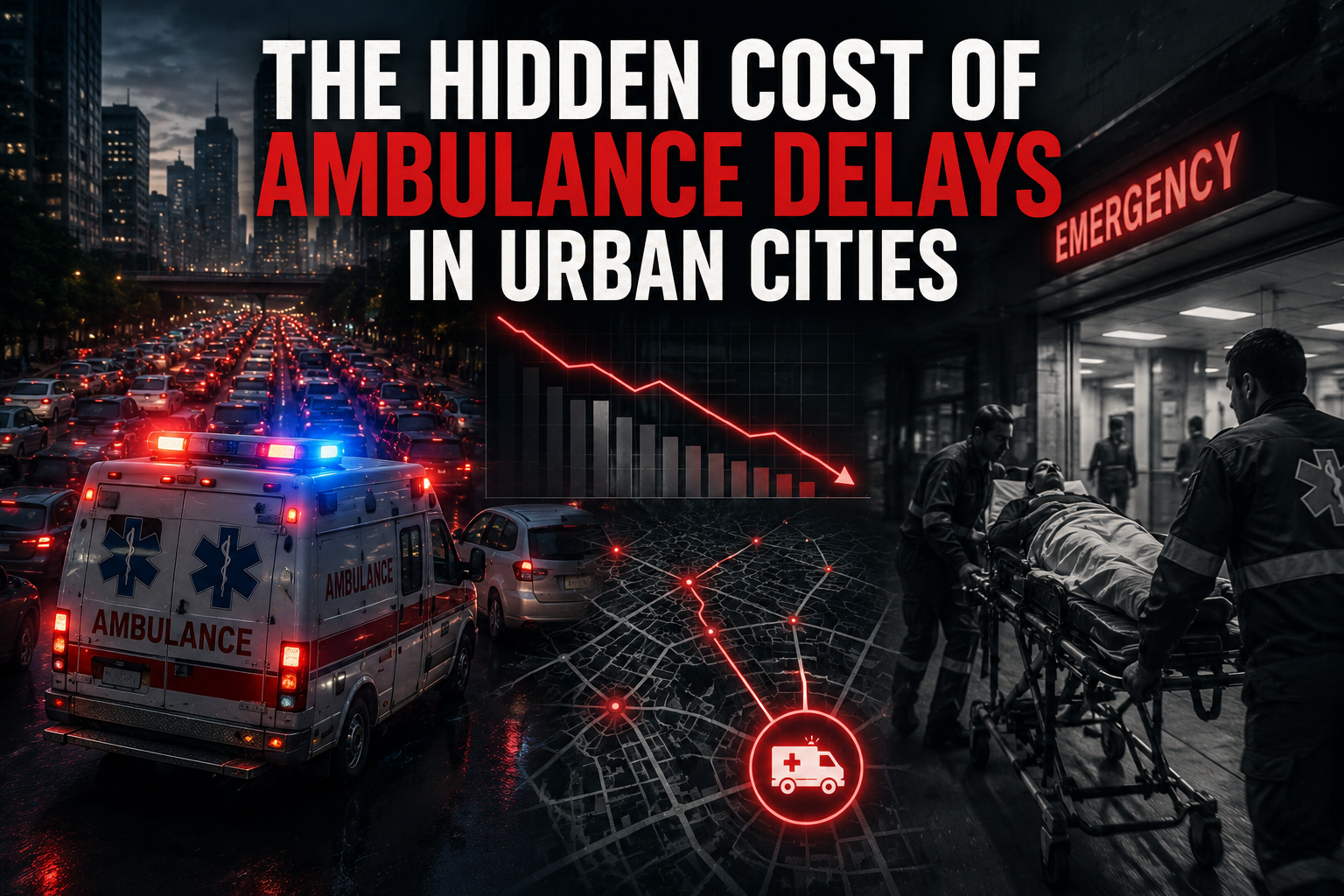
Behind every delayed ambulance is a patient waiting for critical care.
As cities become denser and traffic congestion intensifies, emergency medical systems are facing growing operational pressure. Ambulances frequently lose valuable time at intersections, congested corridors, and poorly synchronized traffic networks.
The Scale of the Problem
In India alone, road accidents claimed an estimated 1.6 lakh lives in 2023, according to national reports. Traffic congestion and delayed emergency access continue to remain major contributors to post-accident mortality.
Even developed urban systems struggle. Recent healthcare reports in England revealed that hundreds of thousands of emergency patients waited more than an hour for ambulances — far exceeding recommended response targets.
The Hidden Costs
Traffic congestion creates cascading costs that extend beyond the immediate medical outcome:
- Increased mortality risk
- Delayed trauma treatment
- Longer hospital stabilization times
- Higher fuel consumption
- Increased urban emissions
- Greater operational stress for emergency responders
Intersections as the Largest Bottleneck
An ambulance may successfully navigate highways, only to lose critical seconds repeatedly at traffic lights. Those repeated interruptions compound into major delays over an emergency route.
This is where intelligent traffic systems become essential. Modern emergency mobility infrastructure can:
- Detect approaching emergency vehicles
- Dynamically clear intersections
- Coordinate multiple traffic signals
- Create uninterrupted "green-wave" corridors
- Reduce stop frequency and idle time
Smarter Cities, Not Just Faster Ambulances
The future of emergency response is not only about faster ambulances. It is about smarter cities.
At Greenwave TechLabs, we see intelligent traffic infrastructure as a core part of public safety — where AI, secure communication, and adaptive signal control work together to protect the most valuable resource in any emergency: time.