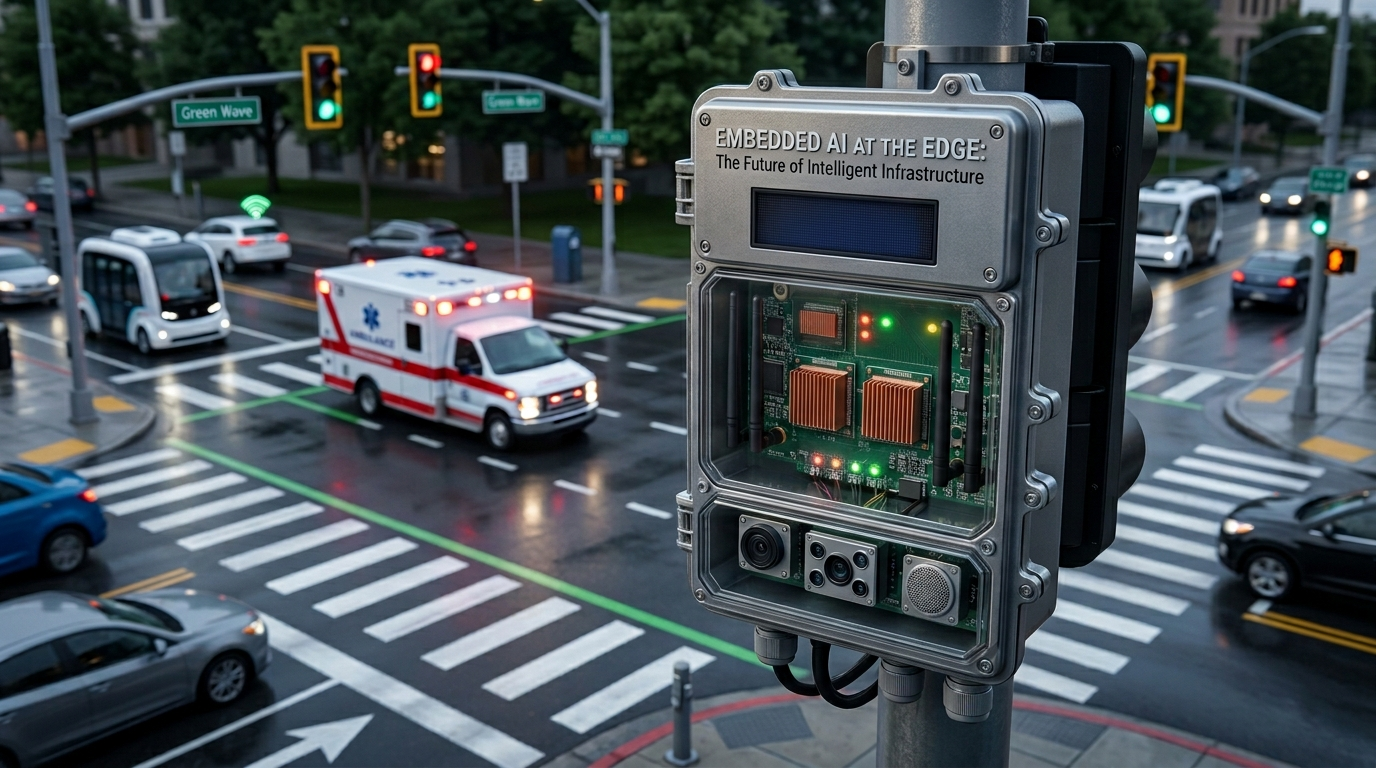
Artificial intelligence is moving beyond cloud servers. A new generation of intelligent systems is emerging where AI runs directly on edge devices embedded inside real-world infrastructure. From smart intersections to industrial automation, edge intelligence is transforming how cities sense, react, and coordinate in real time.
This shift is driven by one core requirement: latency. Critical infrastructure systems cannot always depend on distant cloud servers for decision-making. In emergency response scenarios, even milliseconds matter. Edge AI solves this problem by bringing computation closer to the source of data.
Greenwave TechLabs Edge Architecture
At Greenwave TechLabs, our emergency traffic preemption framework uses embedded AI across multiple layers: CNN-based siren detection, YOLO-powered vehicle recognition, secure LoRa-based V2I communication, and real-time fusion logic.
The architecture was specifically designed to remain operational even under network instability, poor visibility, urban acoustic noise, and partial sensor failure. Unlike traditional cloud-centric systems, edge AI infrastructure can continue functioning independently at intersections and roadside units.
Why Edge AI Matters for Cities
According to Gartner Edge Computing Research, edge computing reduces bandwidth usage and improves response time by processing data near the source rather than transmitting everything to centralized servers. This becomes increasingly important for autonomous mobility, intelligent transportation, industrial IoT, healthcare systems, and public safety infrastructure.
System Performance
- Sub-second signal preemption latency
- 98.6% LoRa packet reliability
- 95.6% siren classification accuracy
- 0.895 mAP visual detection performance
The Broader Significance
Embedded AI is rapidly becoming foundational to next-generation infrastructure because it enables scalability, resilience, energy efficiency, real-time operation, and decentralized intelligence. According to NVIDIA Edge AI Overview, edge AI is expected to power applications ranging from autonomous robotics to intelligent urban systems and industrial automation.
As cities become increasingly connected, infrastructure will no longer operate passively. It will observe, analyze, predict, and respond continuously in real time. The future of intelligent infrastructure will not be defined only by connectivity — it will be defined by intelligence deployed everywhere.