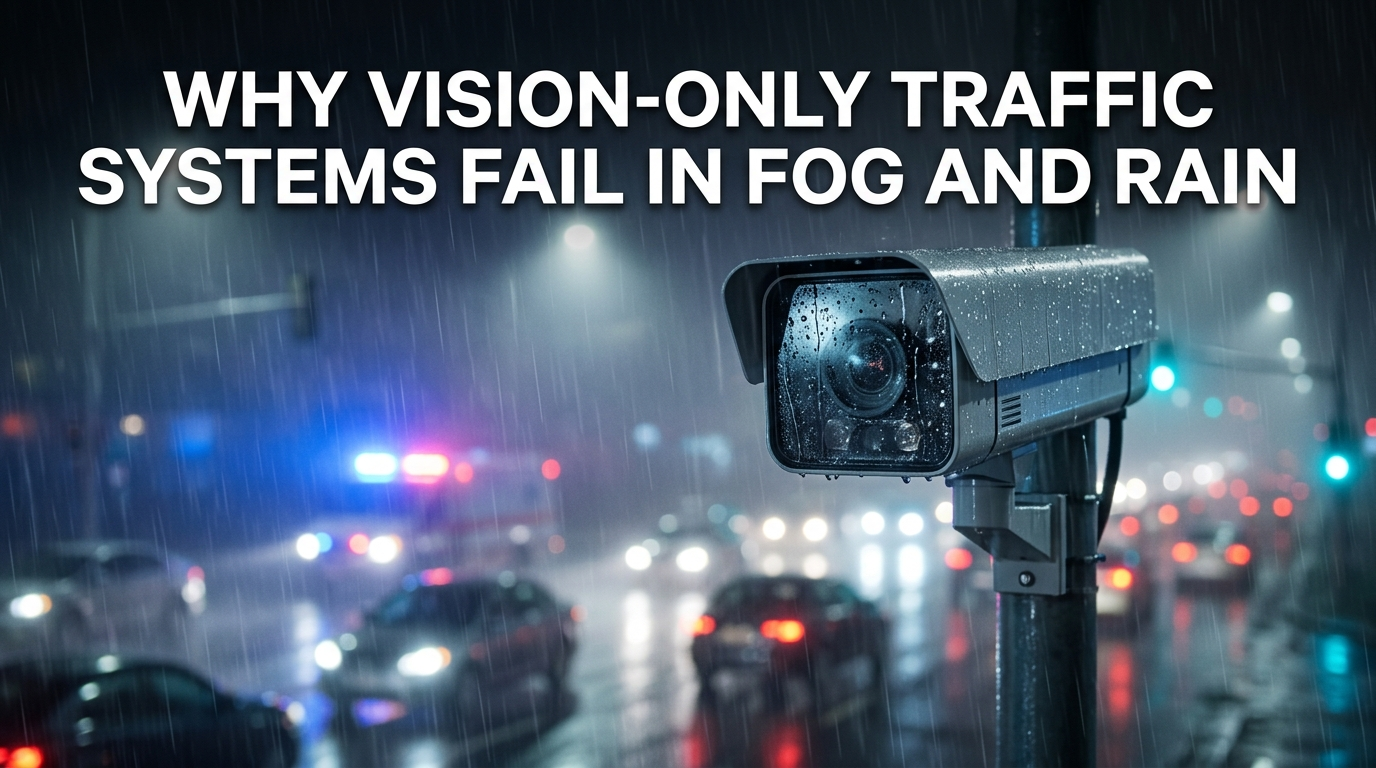
Computer vision has become a central component of modern smart-city infrastructure. Cameras and AI-based detection systems are increasingly used for traffic monitoring, vehicle detection, pedestrian tracking, autonomous mobility, and emergency response coordination.
However, relying exclusively on vision creates serious limitations. Real-world urban environments are unpredictable.
Environmental Challenges for Vision Systems
Weather conditions such as fog, rain, smoke, glare, low light, and night-time visibility can significantly degrade computer vision performance. According to IEEE Intelligent Transportation Systems Society, environmental variability remains one of the biggest challenges in real-world intelligent transportation deployment.
Critical Failure Modes
- Reduced visibility during fog or heavy rain — dense atmospheric conditions reduce image clarity and object contrast
- Night-time degradation — low-light conditions introduce noise, blur, and inconsistent illumination
- Vehicle occlusion — large vehicles or dense traffic can temporarily block emergency vehicles from camera view
- Lens contamination — rain, dust, or glare on camera lenses can disrupt frame quality
- Dependence on line-of-sight — unlike communication-based systems, cameras require direct visual access
Research studies on autonomous mobility and intelligent traffic systems consistently show that environmental conditions remain a major obstacle for robust vision deployment.
The Multi-Modal Solution
At Greenwave TechLabs, this limitation became one of the core motivations behind our multi-modal emergency traffic framework. Our architecture addresses these weaknesses by combining computer vision with secure LoRa communication, acoustic CNN siren detection, and redundant decision fusion.
This means the system can still function even when visual performance temporarily degrades. For example, if fog affects YOLO detection, the acoustic layer may still detect the siren, while the V2I channel can authenticate the emergency vehicle directly.
This redundancy is critical for life-critical infrastructure. Single-sensor systems may work well in controlled environments. But urban deployment requires systems that remain operational under adverse weather, sensor failure, noise, partial obstruction, and unpredictable road conditions.
According to SAE International Automated Driving Research, sensor fusion is becoming essential for robust intelligent transportation systems because no single sensing modality remains reliable under all environmental conditions.
The future of smart mobility will not rely on vision alone. It will rely on intelligent fusion between communication, perception, and embedded AI.