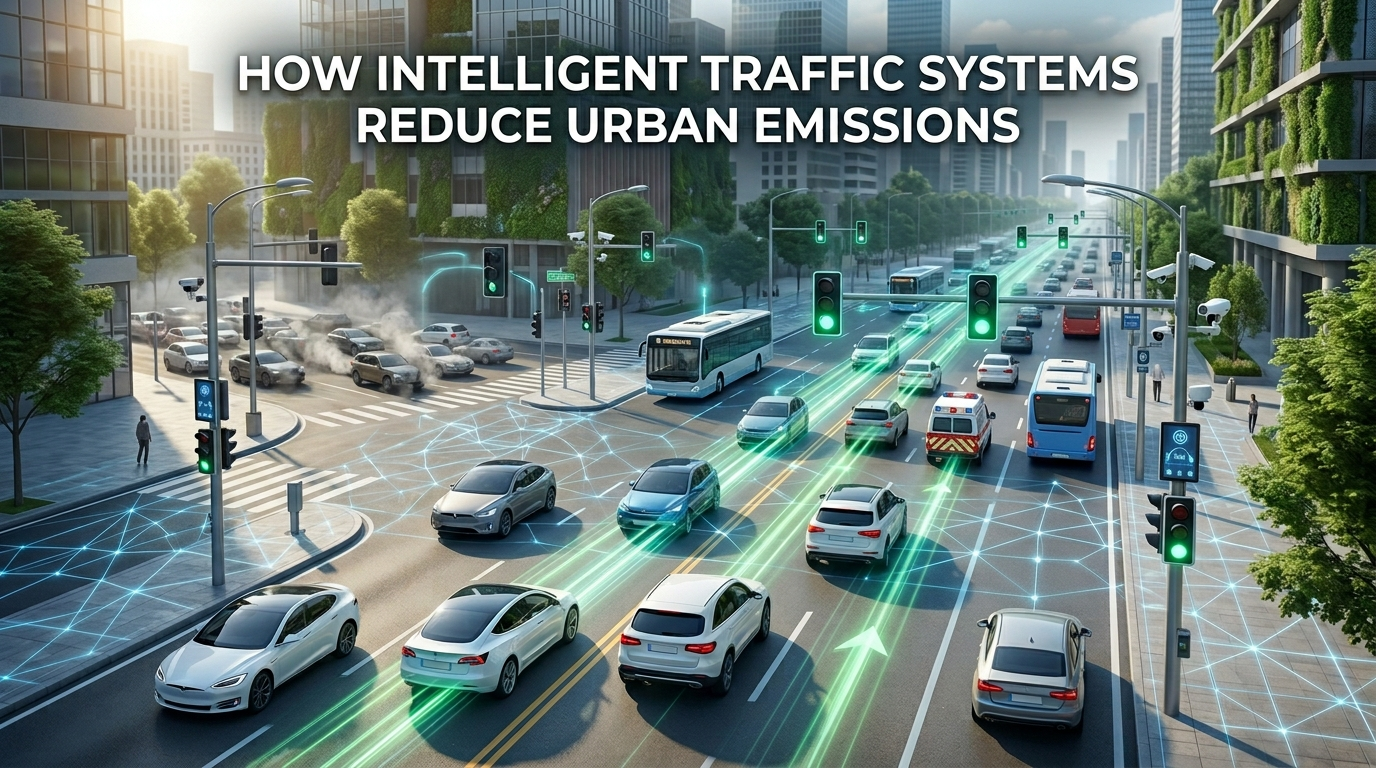
Traffic congestion does not only waste time. It also contributes heavily to urban pollution. When vehicles remain idle at intersections, they continue consuming fuel while releasing carbon dioxide (CO₂), nitrogen oxides (NOx), particulate matter, and greenhouse gases.
According to International Energy Agency Transport Emissions Report, transportation accounts for a major portion of global energy-related CO₂ emissions, with urban congestion significantly increasing fuel inefficiency.
How Adaptive Systems Reduce Emissions
Intelligent traffic systems aim to reduce this waste through real-time adaptive mobility coordination. Adaptive traffic systems reduce emissions by minimizing unnecessary stopping, reducing idle time, improving signal coordination, optimizing traffic movement, and reducing congestion buildup.
Green-wave synchronization is especially effective because it allows vehicles to move continuously through coordinated intersections without repeated acceleration and braking. According to U.S. Department of Energy Fuel Economy Research, aggressive stop-and-go driving significantly increases fuel consumption and emissions.
Greenwave TechLabs Framework
At Greenwave TechLabs, our emergency traffic coordination framework was designed not only for faster emergency response, but also for more efficient traffic flow. Our framework integrates real-time signal coordination, adaptive emergency preemption, AI-driven traffic management, and decentralized edge intelligence to improve both mobility efficiency and infrastructure responsiveness.
Future Possibilities
- Predictive traffic optimization
- AI-based congestion forecasting
- Autonomous vehicle coordination
- Adaptive pedestrian systems
These technologies can contribute toward reduced emissions, improved urban air quality, lower fuel consumption, and more sustainable transportation networks.
According to World Economic Forum Urban Mobility Research, smart mobility infrastructure will play a major role in achieving sustainable urban development goals. Sustainability in transportation is not only about electric vehicles — it is also about making cities move more intelligently.